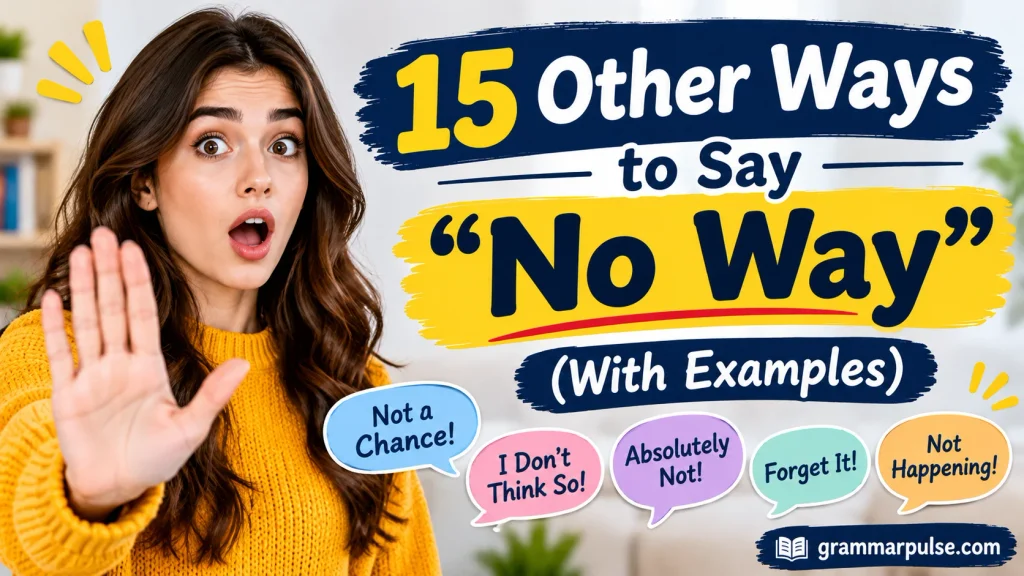
The phrase “No Way” is commonly used in everyday conversations to express surprise, disbelief, excitement, or disagreement. People often use it when they hear something unexpected, receive surprising news, or find it difficult to believe what someone has said. Although this expression is short and easy to understand, using it repeatedly can sometimes make conversations sound predictable or informal. Choosing different words can help you express your feelings more clearly and naturally. Depending on the situation, you might want to show genuine surprise, communicate strong disbelief, or respond with excitement. Learning alternative expressions gives you more flexibility in both spoken and written English.
There are several ways to replace “No Way” while keeping the original meaning and adjusting the tone of your response. For example, expressions such as “You Must Be Kidding,” “I Can’t Believe It,” and “Seriously?” can communicate disbelief in a natural way. If someone shares exciting news, you might say “That’s Amazing!” or “Are You Serious?” to show enthusiasm and interest. On the other hand, when you strongly disagree with an idea or refuse a suggestion, phrases like “Absolutely Not” or “Not a Chance” may be more appropriate. Each expression carries a slightly different meaning and emotional feeling, so understanding its context helps you choose the right words.
Learning different ways to say “No Way” can make your English sound more natural, expressive, and engaging. These alternatives are useful in many situations, including friendly conversations, workplace discussions, text messages, social interactions, and casual emails. Some expressions are perfect for talking with friends, while others communicate a stronger or more professional response. Understanding these differences also helps you avoid misunderstandings and express your thoughts with greater confidence. Whether you want to show shock, excitement, disbelief, or refusal, having different expressions in your vocabulary makes communication easier. In this article, we will explore 15 useful alternatives to “No Way,” along with their meanings and practical examples to help you use each phrase correctly.
What Does “No Way” Mean?
“No way” is an informal English expression with several common meanings. It can communicate strong disbelief, surprise, excitement, or refusal, depending on the context and the speaker’s tone. When someone shares unbelievable news, saying “No way!” usually means you are surprised and want to express that reaction. For example, if your friend says they won a competition, you might respond, “No way! That’s amazing!”
The expression can also mean absolutely not or I refuse to do that. For instance, if someone asks you to do something unreasonable, you might say, “No way, I’m not doing that.” In this situation, the phrase sounds firm and direct rather than surprised.
Context makes all the difference. A cheerful “No way!” can express excitement, while a serious “No way” can communicate disagreement or rejection. Understanding these differences helps you choose an alternative that matches your actual feelings.
Common Situations Where “No Way” Is Used
People use “No way” in many everyday situations, especially when they want to react quickly or express strong emotions.
- Everyday conversations: People say it when they hear unexpected news or something difficult to believe.
- Text messages: Friends often use it to react to exciting updates, surprising stories, or unbelievable situations.
- Social media: It works as a short reaction to unexpected announcements, impressive achievements, and surprising posts.
- Relationships: Partners may use it playfully to express excitement, disbelief, or disagreement.
- School and friendships: Students use it when reacting to surprising grades, invitations, competitions, or unexpected events.
- Workplace conversations: Colleagues might use it informally when discussing surprising developments. However, more measured wording can be better in professional settings.
- Personal communication: It can express a strong refusal when someone suggests something you genuinely don’t want to do.
Sometimes, people want an alternative because they don’t want to sound too dramatic, negative, or casual. A softer expression can make a refusal more respectful, while an enthusiastic response can make good news feel even more exciting.
Is It Professional or Polite to Say “No Way”?
“No way” is generally casual and informal. It is perfectly acceptable between friends, family members, and people who have a relaxed relationship. In these situations, it can sound friendly, funny, or enthusiastic.
However, the expression may sound too blunt in professional communication, particularly when you’re rejecting a request or disagreeing with someone. For example, responding “No way” to a manager’s suggestion could seem dismissive. Saying “I don’t think that’s possible” or “I’m afraid that won’t work” communicates the same general refusal more respectfully.
When expressing surprise at work, “Really?” or “That’s surprising” may sound more appropriate. The goal isn’t to avoid the original phrase completely. Instead, choose wording that matches the relationship, situation, and intended emotion.
Advantages and Disadvantages of Saying “No Way”
The expression has several benefits, but it also has limitations worth understanding.
Advantages
- Easy to understand: Most English speakers recognize the expression immediately.
- Emotionally expressive: It communicates surprise, excitement, disbelief, or refusal without requiring a long explanation.
- Natural in casual conversations: It fits comfortably into everyday discussions.
- Versatile: Its meaning can change depending on tone and context.
- Memorable: Its short, direct structure makes it useful for quick reactions.
Disadvantages
- Can sound too direct: When used to reject an idea, it may appear rude or dismissive.
- Limited emotional detail: It doesn’t always explain whether you’re surprised, excited, or genuinely disagreeing.
- Too informal for some settings: It may not suit business emails, formal discussions, or customer communication.
- Can become repetitive: Using it in every surprising situation makes your responses less expressive.
- May cause misunderstandings: Without the right tone, someone might interpret excitement as disbelief or rejection.
15 Best Synonyms of “No Way”
Here are 15 natural alternatives you can use depending on your feelings and the situation.
- Absolutely Not
- Not a Chance
- No Chance
- You’re Kidding!
- Are You Serious?
- You’ve Got to Be Kidding Me!
- I Can’t Believe It!
- That’s Impossible!
- Not in a Million Years
- I Don’t Think So
- Out of the Question
- No Way in Hell
- You’ve Got to Be Joking!
- Seriously?
- That’s Unbelievable!
Note: These expressions are not all exact synonyms. Some communicate surprise, while others express refusal or disbelief.
1. Absolutely Not
Meaning
“Absolutely not” is a strong and direct way to reject an idea, suggestion, request, or possibility. It communicates complete disagreement or refusal without leaving much room for uncertainty.
Unlike “No way,” which can express several emotions, this expression focuses mainly on firm rejection.
Definition
A clear and emphatic refusal that means something is completely unacceptable or will not happen.
Detailed Explanation
This expression sounds more deliberate than the original phrase. It works when you want to establish a boundary or make your decision clear. Although it can sound serious, it doesn’t have to be rude when delivered calmly. You can also use it in professional situations when a direct answer is necessary.
Scenario Examples
Scenario: A friend asks to borrow your car without permission.
Example: “Absolutely not! You need to ask me before taking it.”
Scenario: A colleague suggests skipping an important safety check.
Example: “Absolutely not. We need to complete the inspection first.”
Best Use
Use this expression when refusing unreasonable requests, setting personal boundaries, or rejecting inappropriate suggestions. It also works in serious workplace discussions.
Tone
Tone: Firm, confident, direct, and sometimes authoritative.
It communicates certainty and makes your position difficult to misunderstand.
2. Not a Chance
Meaning
“Not a chance” means something is extremely unlikely to happen or that you strongly refuse to do something. It is a natural conversational alternative when you want to sound confident and decisive.
It often carries a slightly playful feeling in casual conversations.
Definition
An informal expression meaning there is no possibility of something happening or being accepted.
Detailed Explanation
This phrase is particularly useful when someone asks whether you will agree to something. It sounds confident without necessarily being aggressive. Depending on your delivery, it can express humor, determination, or serious refusal. Compared with “Absolutely not,” it often feels more conversational.
Scenario Examples
Scenario: Your friend challenges you to eat an extremely spicy pepper.
Example: “Not a chance! I know I’ll regret that.”
Scenario: Someone asks whether you will miss an important deadline.
Example: “Not a chance. I’ll have everything ready before Friday.”
Best Use
Use it in casual conversations, friendly challenges, personal boundaries, and situations where you want to communicate strong confidence.
Tone
Tone: Confident, casual, determined, and sometimes humorous.
It makes your response sound decisive without requiring a lengthy explanation.
3. No Chance
Meaning
“No chance” expresses the idea that something is impossible, highly unlikely, or not going to happen. It can communicate disbelief about an outcome or rejection of a suggestion.
It is similar to “Not a chance,” although the two expressions can have slightly different emphasis.
Definition
A phrase indicating that there is little or no possibility of something happening.
Detailed Explanation
People commonly use this expression when discussing predictions, opportunities, or unlikely situations. It can sound less personal than a direct refusal because it sometimes describes the situation rather than the speaker’s decision. However, it can still communicate a strong rejection when used as a standalone response. The surrounding conversation determines its meaning.
Scenario Examples
Scenario: Your friend thinks their team will win despite being far behind.
Example: “No chance! They’re already five goals behind.”
Scenario: Someone asks whether you can attend an event tomorrow.
Example: “No chance tomorrow. I’ve got a full schedule.”
Best Use
Use this expression when discussing unlikely outcomes, rejecting suggestions casually, or explaining why something cannot happen.
Tone
Tone: Direct, casual, skeptical, and sometimes dismissive.
It works well when the conversation doesn’t require a particularly formal response.
4. You’re Kidding!
Meaning
“You’re kidding!” expresses surprise or disbelief when someone shares unexpected information. It suggests that what you’ve heard sounds so surprising that you initially struggle to believe it.
Unlike a firm refusal, this phrase usually communicates an emotional reaction.
Definition
An informal expression used to show surprise or disbelief about something someone has said.
Detailed Explanation
This phrase is especially natural when responding to exciting or unexpected news. It can sound playful when spoken between friends. However, it doesn’t always mean you believe the other person is actually joking. Often, you’re simply expressing how surprising their statement feels. Your facial expression and voice help communicate the intended meaning.
Scenario Examples
Scenario: Your friend announces that they’re moving abroad.
Example: “You’re kidding! When did you make that decision?”
Scenario: Your classmate says they finished an entire project overnight.
Example: “You’re kidding! That’s impressive.”
Best Use
Use it when reacting to surprising news, unexpected announcements, or unbelievable stories shared by people you know.
Tone
Tone: Playful, surprised, friendly, and informal.
It creates a relaxed reaction that invites the other person to explain more.
5. Are You Serious?
Meaning
“Are you serious?” is a question used to express surprise, disbelief, or concern about something someone has said.
It can also communicate excitement when someone shares genuinely good news.
Definition
A question asking whether someone truly means what they have just said or whether their statement is genuine.
Detailed Explanation
This expression is more conversational than a simple refusal. It gives the other person an opportunity to confirm or explain their statement. Depending on your voice, it can sound excited, doubtful, or slightly annoyed. It is especially useful when you want to continue the conversation rather than immediately dismiss what you’ve heard.
Scenario Examples
Scenario: Your friend tells you they received a promotion.
Example: “Are you serious? That’s fantastic news!”
Scenario: Your brother says he forgot his passport before an international flight.
Example: “Are you serious? How did you manage that?”
Best Use
Use it in face-to-face conversations, text messages, and informal discussions when you need clarification or want to express surprise.
Tone
Tone: Curious, surprised, conversational, and sometimes skeptical.
Its question format makes it especially useful for keeping a conversation going.
6. You’ve Got to Be Kidding Me!
Meaning
“You’ve got to be kidding me!” expresses strong disbelief, frustration, or shock. People use it when something seems extremely surprising, unreasonable, or difficult to accept.
It usually carries more emotional intensity than “No way.”
Definition
An informal expression showing that something seems too surprising, frustrating, or unbelievable to be true.
Detailed Explanation
This phrase is particularly effective when an unexpected situation leaves you speechless. It can communicate excitement, but it more commonly expresses disbelief or frustration depending on the circumstances. Compared with shorter alternatives, it sounds more dramatic and emotionally charged. Use it when you want your reaction to be unmistakable.
Scenario Examples
Scenario: You discover that your flight has been delayed for another six hours.
Example: “You’ve got to be kidding me! We were already waiting for three hours.”
Scenario: Your friend reveals that they won two prizes in one evening.
Example: “You’ve got to be kidding me! That’s incredible!”
Best Use
Use it in informal conversations, humorous situations, and moments of unexpected frustration or excitement. Avoid it in sensitive professional discussions.
Tone
Tone: Dramatic, emotional, expressive, and informal.
It adds strong personality to a reaction.
7. I Can’t Believe It!
Meaning
“I can’t believe it!” expresses shock, surprise, excitement, or disbelief when something unexpected happens.
It is particularly useful when you want to communicate a strong emotional reaction without sounding dismissive.
Definition
An expression showing that something is so surprising or unexpected that it is difficult to accept as true.
Detailed Explanation
This phrase is more emotionally descriptive than the original expression. It focuses on your personal reaction rather than rejecting someone else’s statement. It can communicate happiness, sadness, shock, or disappointment. That flexibility makes it suitable for many personal situations.
Scenario Examples
Scenario: Your best friend tells you they got accepted into their dream university.
Example: “I can’t believe it! You worked so hard for this.”
Scenario: You discover that someone has been using your ideas without giving you credit.
Example: “I can’t believe it. That’s incredibly disappointing.”
Best Use
Use it when reacting to major announcements, personal achievements, unexpected events, or emotional news.
Tone
Tone: Emotional, sincere, surprised, and expressive.
It highlights how deeply an unexpected event has affected you.
8. That’s Impossible!
Meaning
“That’s impossible!” communicates that something seems impossible, unrealistic, or inconsistent with what you know.
It is a stronger alternative when you genuinely doubt that a particular event or situation could happen.
Definition
A direct statement expressing the belief that something cannot happen or cannot be true.
Detailed Explanation
This expression focuses more on the possibility of an event than on your personal feelings. It can sound logical when discussing facts, but it may also sound emotional when reacting to shocking news. Be careful when using it because something that seems impossible to you may simply be unexpected. Asking for clarification can sometimes be better.
Scenario Examples
Scenario: Your friend claims they completed a difficult assignment in five minutes.
Example: “That’s impossible! It usually takes an hour.”
Scenario: A colleague tells you that the entire system was repaired in seconds.
Example: “That’s impossible. We should check the maintenance report.”
Best Use
Use it when questioning an unlikely claim, discussing practical limitations, or expressing strong disbelief.
Tone
Tone: Skeptical, direct, logical, and sometimes dramatic.
It sounds stronger when you challenge the truth or possibility of a statement.
Read More: 15 Other Ways to Say “As Per Your Request” (With Examples)
9. Not in a Million Years
Meaning
“Not in a million years” is an emphatic expression meaning you would never do something or that something is extremely unlikely to happen.
It is especially useful when you want to communicate a strong personal refusal.
Definition
An informal phrase meaning something will never happen, even after an extremely long time.
Detailed Explanation
This expression is more dramatic than a simple refusal. It often adds humor or exaggeration to a negative response. People use it when they want to make their feelings especially clear. It is not usually appropriate for delicate professional situations because it can sound overly emotional or dismissive.
Scenario Examples
Scenario: Your friend asks whether you would go skydiving without proper preparation.
Example: “Not in a million years! I’m terrified of heights.”
Scenario: Someone asks whether you would reveal your friend’s private secret.
Example: “Not in a million years. I would never betray their trust.”
Best Use
Use it for strong personal preferences, playful disagreements, dramatic refusals, and informal conversations.
Tone
Tone: Dramatic, humorous, firm, and emphatic.
The exaggeration makes your refusal memorable.
10. I Don’t Think So
Meaning
“I don’t think so” is a softer way to disagree with someone or reject a suggestion. It communicates doubt or a negative response without sounding as forceful as an outright refusal.
Definition
A polite or conversational expression indicating that you disagree or believe something is unlikely.
Detailed Explanation
This expression is useful when you want to disagree without creating unnecessary tension. It sounds more measured than “No way” and allows room for further discussion. However, it can sometimes communicate uncertainty rather than a definite refusal. In professional conversations, the phrase is often appropriate when followed by a brief explanation.
Scenario Examples
Scenario: A friend asks whether the restaurant is still open.
Example: “I don’t think so. It usually closes around nine.”
Scenario: A coworker suggests completing a large project in one afternoon.
Example: “I don’t think so. We’ll probably need another day.”
Best Use
Use it in polite disagreements, workplace discussions, everyday conversations, and situations where you want to sound reasonable rather than confrontational.
Tone
Tone: Calm, thoughtful, polite, and mildly skeptical.
It softens disagreement while still communicating your position.
11. Out of the Question
Meaning
“Out of the question” means something is not acceptable, possible, or open for consideration.
It is a useful expression when you want to establish a firm boundary or reject a proposal.
Definition
A phrase describing something that cannot be considered or accepted under the circumstances.
Detailed Explanation
Unlike a casual reaction, this expression often communicates a settled decision. It is particularly effective when discussing rules, boundaries, plans, or important decisions. It can sound professional when used calmly, although it may seem harsh if delivered without explanation. Adding a short reason can make the refusal more respectful.
Scenario Examples
Scenario: Your child asks to use the family car without a driving license.
Example: “Driving without a license is out of the question.”
Scenario: A business partner proposes ignoring an important contract requirement.
Example: “Skipping the approval process is out of the question.”
Best Use
Use it when discussing firm boundaries, workplace policies, serious decisions, and unacceptable suggestions.
Tone
Tone: Authoritative, serious, firm, and decisive.
It communicates that a particular option is not open for discussion.
12. No Way in Hell
Meaning
“No way in hell” is a very strong and informal expression of refusal or disbelief. It communicates that you strongly oppose something or consider it completely unacceptable.
Definition
A forceful expression meaning absolutely not, with added emotional intensity.
Detailed Explanation
This phrase is considerably stronger than the original expression. It often conveys anger, frustration, determination, or dramatic humor. Because it includes profanity-related language, it can sound offensive or inappropriate in certain situations. It is best reserved for conversations with people who understand your communication style.
Scenario Examples
Scenario: A friend suggests lending money to someone who repeatedly refuses to repay you.
Example: “No way in hell! I’m not making that mistake again.”
Scenario: Someone jokingly suggests that you should eat an entire cake alone.
Example: “No way in hell! I’d need a week to recover.”
Best Use
Use it in very informal conversations, strong personal refusals, and humorous exchanges with close friends. Avoid it in professional emails and customer communication.
Tone
Tone: Aggressive, emphatic, emotional, and highly informal.
Its intensity makes it unsuitable when politeness matters.
13. You’ve Got to Be Joking!
Meaning
“You’ve got to be joking!” expresses disbelief when something sounds surprising, ridiculous, or difficult to accept.
It suggests that the speaker hopes or assumes the other person isn’t being completely serious.
Definition
An informal expression used when something seems too unexpected or unbelievable to be true.
Detailed Explanation
This phrase is closely related to “You’re kidding!” but can sound more dramatic. It works particularly well when someone shares an unexpected situation or makes a surprising statement. It can also communicate frustration when something goes wrong. The exact feeling depends on your delivery and the surrounding conversation.
Scenario Examples
Scenario: Your friend tells you that the concert tickets sold out in seconds.
Example: “You’ve got to be joking! I was ready to buy them.”
Scenario: Your roommate says they accidentally deleted an important document.
Example: “You’ve got to be joking! Didn’t you save a backup?”
Best Use
Use it when responding to surprising announcements, unexpected mistakes, and unbelievable situations in casual conversations.
Tone
Tone: Playful, skeptical, dramatic, and informal.
It communicates disbelief while inviting the other person to clarify what happened.
14. Seriously?
Meaning
“Seriously?” is a short question used to express surprise, disbelief, annoyance, or genuine curiosity.
It can replace “No way” when you want a quick reaction without using a longer expression.
Definition
An informal question asking whether something is true or whether someone genuinely means what they said.
Detailed Explanation
The strength of this expression depends heavily on your voice and punctuation. A cheerful “Seriously?” can show excitement, while a sharp version can communicate irritation. It is especially common in spoken English and text messages because it is short and easy to understand. However, it can sound sarcastic when used in the wrong situation.
Scenario Examples
Scenario: Your friend tells you they have never watched a popular movie.
Example: “Seriously? You’ve never seen it?”
Scenario: Your colleague announces that the meeting has been moved to an earlier time.
Example: “Seriously? I thought we had agreed on the original schedule.”
Best Use
Use it in casual conversations, text messages, friendly discussions, and situations where you want an immediate reaction.
Tone
Tone: Curious, surprised, casual, and sometimes sarcastic.
Its short format makes it suitable for quick exchanges.
15. That’s Unbelievable!
Meaning
“That’s unbelievable!” expresses strong surprise or disbelief about something remarkable, unexpected, or difficult to accept.
Unlike expressions that focus on refusing an idea, this phrase mainly describes your reaction to an event or statement.
Definition
A statement expressing that something is extremely surprising, extraordinary, or difficult to believe.
Detailed Explanation
This expression can communicate both positive and negative emotions. You might use it when someone achieves something remarkable or when you hear about an unfair situation. It is slightly more polished than some slang alternatives, although it remains natural in everyday English. Its emotional meaning becomes clear through the surrounding conversation.
Scenario Examples
Scenario: Your friend tells you they completed a marathon after months of training.
Example: “That’s unbelievable! You should be incredibly proud.”
Scenario: You hear that a customer waited several hours for a simple service.
Example: “That’s unbelievable! They should have handled the situation much sooner.”
Best Use
Use it when reacting to extraordinary achievements, shocking news, remarkable events, or frustrating situations.
Tone
Tone: Expressive, emotional, enthusiastic, and sometimes disapproving.
It emphasizes how extraordinary or unexpected something feels.
FAQs:
1. What is another way to say “No Way”?
Some common alternatives include “Absolutely Not,” “Not a Chance,” “Seriously?” “I Can’t Believe It,” and “You Must Be Kidding.” The best choice depends on whether you want to express surprise, disbelief, or refusal.
2. Is “No Way” formal or informal?
“No Way” is generally an informal expression used in everyday conversations. It is suitable for chatting with friends, family, and coworkers in casual situations but may not be appropriate for formal business communication.
3. How do you say “No Way” professionally?
You can use professional alternatives such as “I Don’t Think So,” “That Would Not Be Possible,” “I Must Disagree,” or “Unfortunately, That’s Not an Option.” These expressions communicate disagreement or refusal more politely.
4. Can “No Way” express excitement or surprise?
Yes. “No Way” can express excitement, shock, or amazement when someone shares unexpected news. For example, if your friend tells you they won a competition, you might respond, “No way! That’s amazing!”
5. What is a polite alternative to saying “No Way”?
Polite alternatives include “I’m Afraid Not,” “I Don’t Think That’s Possible,” “Unfortunately, I Can’t,” and “I Appreciate the Offer, but I Must Decline.” These phrases help you disagree or refuse without sounding rude.
Conclusion
Choosing the right expression makes your communication clearer and more natural. Although “No way” is a useful phrase, it doesn’t always express the exact emotion you want to communicate. Sometimes, you want to show excitement. Other times, you need to express disbelief, disagree politely, or establish a firm boundary.
Expressions such as “Absolutely not,” “I can’t believe it,” “Not a chance,” and “That’s unbelievable!” offer different ways to respond. Remember that similar phrases don’t always have identical meanings. Some are playful, while others sound serious or strongly negative. Consider your audience, relationship, and situation before choosing your words. The best alternative is the one that communicates your feelings accurately while keeping the conversation comfortable and respectful.



One Response